US School Path
US School Path
Moving to the USA and school:
what I wish I had known earlier
I went from a regular high school in Russia to studying in a highly competitive academic environment in the United States.
The transition wasn’t easy—I had to adapt to a completely new system, overcome language barriers, and learn in a different language.


Elementary school


Relocation

Adaptation and Challenges

High School and College Admissions
After making plenty of mistakes and learning many lessons along the way, I realized that I could help other students and their families navigate this journey with more confidence and less uncertainty. This website combines my personal experience with my interest in artificial intelligence.
I created an AI assistant designed to help students and parents better understand the U.S. education system, avoid common pitfalls, and focus on what truly matters when preparing for high school and college in the United States.

Ask AI assistant
The answers are based on personal experience and carefully researched information.
The information on this website does not constitute professional advice.
My Journey in the United States
At the time of our move, we had no idea how important each year of high school (grades 9–12) would be for future college admissions. We came to understand this only later in the process, and as a result, some valuable time was lost.
1
Public School
8th Grade: a new country, a new language, new people, and a completely different education system. Yet despite all these changes, the academic workload was surprisingly light. That’s when my parents began to worry...
2
Moving to a More Challenging School
Starting in 9th grade, I transferred to a school with a much stronger academic environment. It was there that the difference in academic standards, expectations, and level of rigor became truly apparent.
3
Adaptation and Challenges
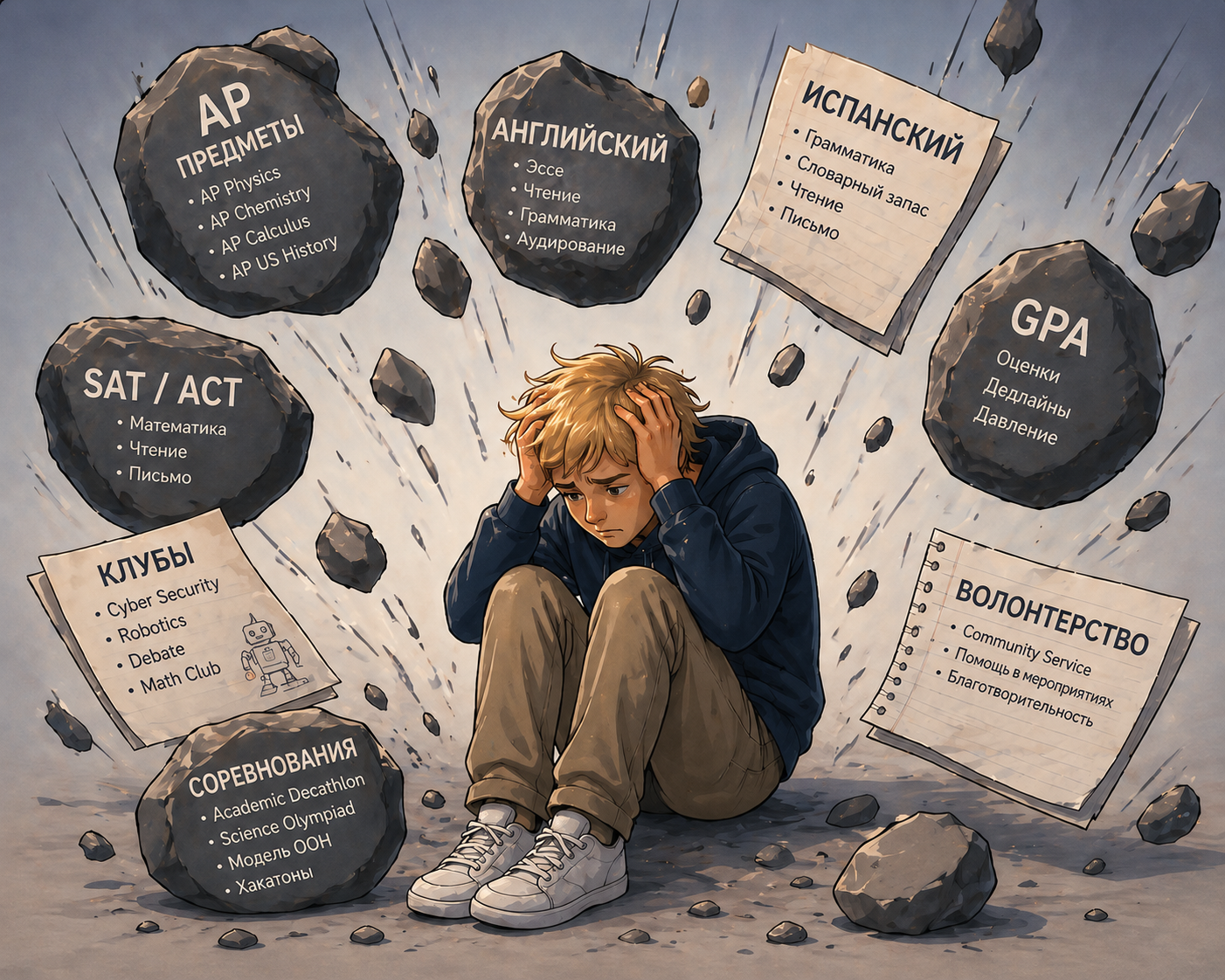
9th grade and the beginning of 10th grade were especially challenging. New subjects, demanding coursework, and high academic expectations significantly increased the workload and had a noticeable impact on my grades.

4
Growth and results
Over time, I was able to adapt and reach a strong academic level:
- Strong performance in STEM subjects
- Recipient of the Student of the Year award in Physics
- Participation in the Academic Decathlon, including competition at the national level
Today, I am a junior in high school, taking a rigorous schedule of AP courses, participating in the Cybersecurity Club, studying AI, and preparing for the SAT and ACT.
What I realized
College admission in the United States is not a single step—it is the result of several years of decisions and preparation.
Many factors that seem unimportant at first can have a significant impact on the final outcome.
Without a clear strategy, it is easy to lose valuable time.
What Matters Most in High School

Academic Workload
☑️ AP and Honors courses matter
☑️ It is important to take challenging courses while maintaining a healthy balance

Grades and Academic Progress
☑️ GPA is important
☑️ Academic growth and improvement over time are just as important
☑️ More challenging courses carry greater weight in GPA calculations

Activities and Involvement
☑️ Clubs and competitions
☑️ Not just participation, but meaningful involvement and commitment

Focus and Depth
☑️ It is better to focus on 2–3 meaningful areas than to participate in many unrelated activities
☑️ It is important to build your profile around your genuine interests and strengths

Strengthening Your Profile
☑️ Summer programs
☑️ Personal projects
⭐ One of the most effective ways to stand out in the college admissions process

Strategy and Timing
☑️ Plan several years ahead
☑️ 9th grade is more important than many students realize
☑️ Mistakes can cost valuable time and opportunities

If you understand these things early on, the journey becomes much clearer and more manageable.
Helpful Resources
During my time studying in the United States, I came across many articles, guides, and personal stories from students. The resources below were especially helpful to me and provided valuable insights into the admissions process, college essays, and student life in the U.S.
Admissions & Strategy
One of the most well-known articles about college admissions. It explains why you shouldn't build your entire life around getting into college and why genuine interests matter more than a “perfect” résumé.
An article explaining why admissions officers value authenticity and want to see a real person behind the application, rather than just a list of accomplishments.
Official information on how the University of California evaluates applicants and the factors considered during the admissions process.
Projects, Activities & Essays
An article about the importance of extracurricular activities.
Examples of activities that help develop leadership, initiative, and real-world skills.
Tips for writing a personal essay and telling your story.
A good way to understand what makes a strong personal essay.
Student Stories
A Russian student's story about college admissions, adapting to life in the U.S., finding internships, and studying in America.
A girl from Moscow shares her fears, adjustment, and studies.
Practical resources on international student life, visas, choosing a college, and adapting to life in the U.S.
These resources do not offer a universal formula for admission, because one simply does not exist. But they help explain the system and show the process through the eyes of both universities and students.
A Few Final Thoughts
Studying in the United States is a challenging journey, but it becomes much more manageable when you understand the system from the start. With the right planning and preparation, many common mistakes can be avoided.

I share this information not as a professional consultant, but as someone who has gone through—and continues to go through—this journey firsthand.

The information on this website represents only a small part of the experience and understanding that develop over time. It is impossible to capture every nuance on a single page, which is why I chose to place the main focus on the AI assistant.

Since these are my first steps in this field, I hope you won’t judge too harshly. I would genuinely appreciate any feedback, comments, or suggestions. Based on your input—and as I continue developing my skills—I will keep improving and expanding the AI assistant.

Feel free to reach out to me by email. I will do my best to respond and share what I have learned. If time permits, I would also be happy to connect personally via Zoom or Google Meet.
AI assistant
If you have any questions...
Thank you for taking the time to visit. I hope you found this website helpful and informative.
2026 - Matvey Morozov